

Hair Transplant
in Indore — by the doctor himself
Dr. Abhishek Malviya has performed more than 5,000 hair transplants, and he performs them personally. MD in Dermatology, former Assistant Professor at AIIMS, 15+ years in practice. FUE in a single day under local anaesthesia at Radiant, Pipliyahana — priced per graft, with your graft count and the full cost in writing before you commit.
- MD — Dermatology (DVL)
- Ex-Assistant Professor, AIIMS
- 5,000+ transplants
- Top 3 in Indore — ThreeBestRated

If you are choosing a hair transplant in Indore, the question to settle first is not which clinic has the smartest reception. It is who holds the punch. At Radiant Skin, Hair & Laser Clinic, Pipliyahana, Dr. Abhishek Malviya performs the extraction, the recipient site creation and the implantation himself — not a technician working under his name.
He is an MD dermatologist, a former Assistant Professor of Dermatology at AIIMS, and has performed over 5,000 hair transplants across 15+ years. Surgery is priced per graft and the graft count and total are given to you in writing before you decide anything. Patients whose loss has not stabilised, or whose donor area cannot support what they are asking for, are told so and sent away on medical therapy instead.
That is the case for Radiant. Everything below is the evidence — real patient results with graft counts, what actually differs between clinics quoting the same price, and the four things worth checking before you book anywhere.
Patients treated at Radiant, Indore
Photographed from fixed angles under the same lighting, and published with written patient consent. Click any case to enlarge.
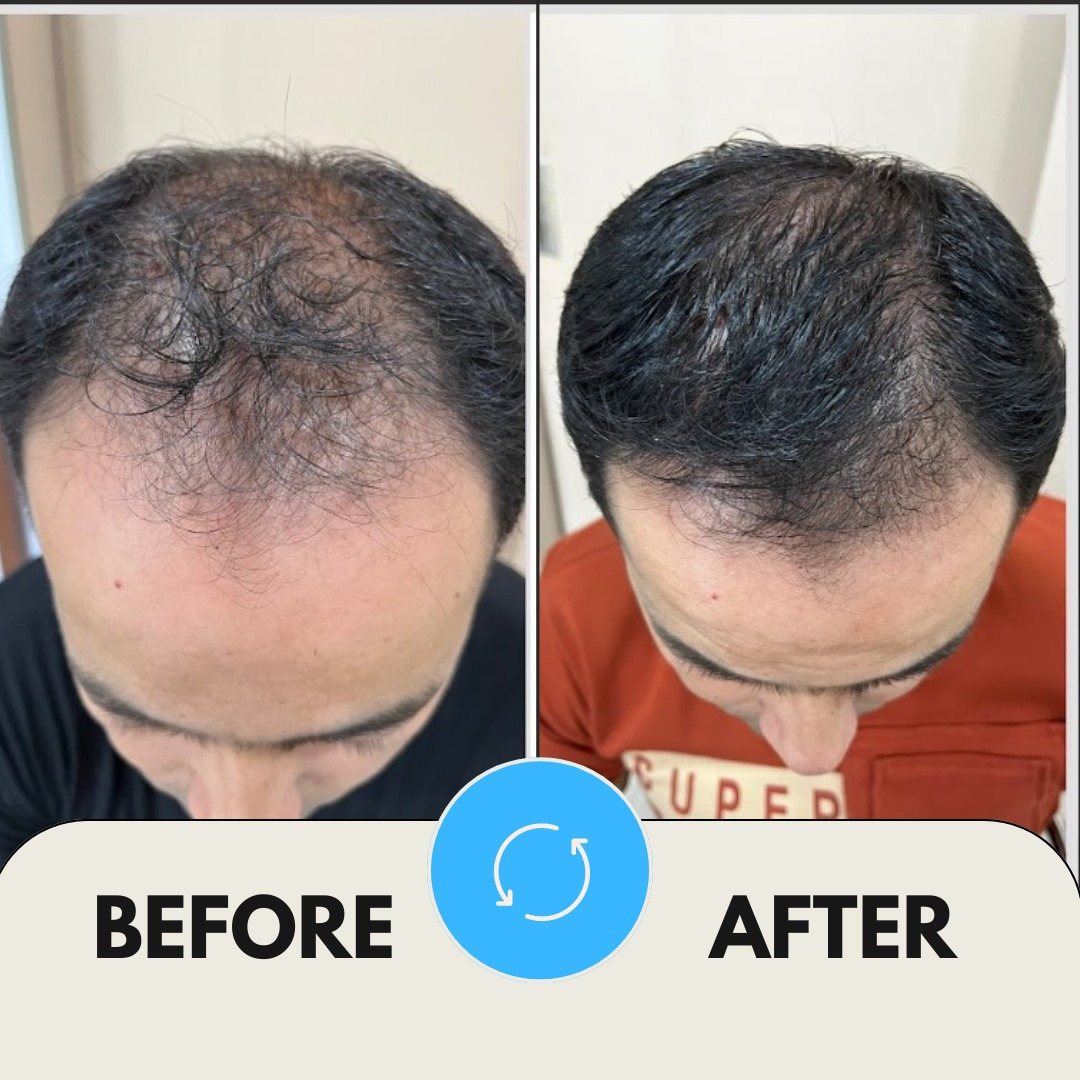
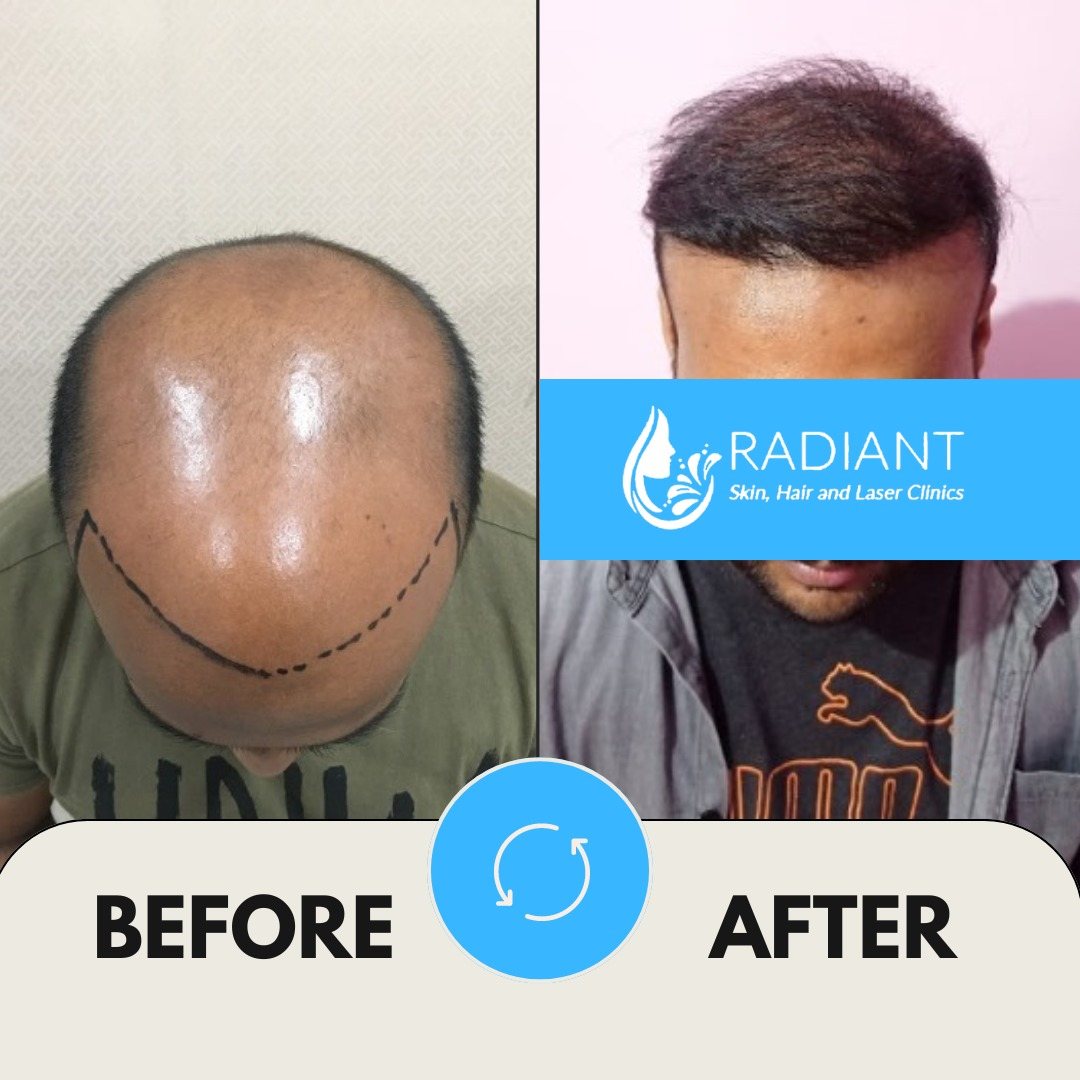
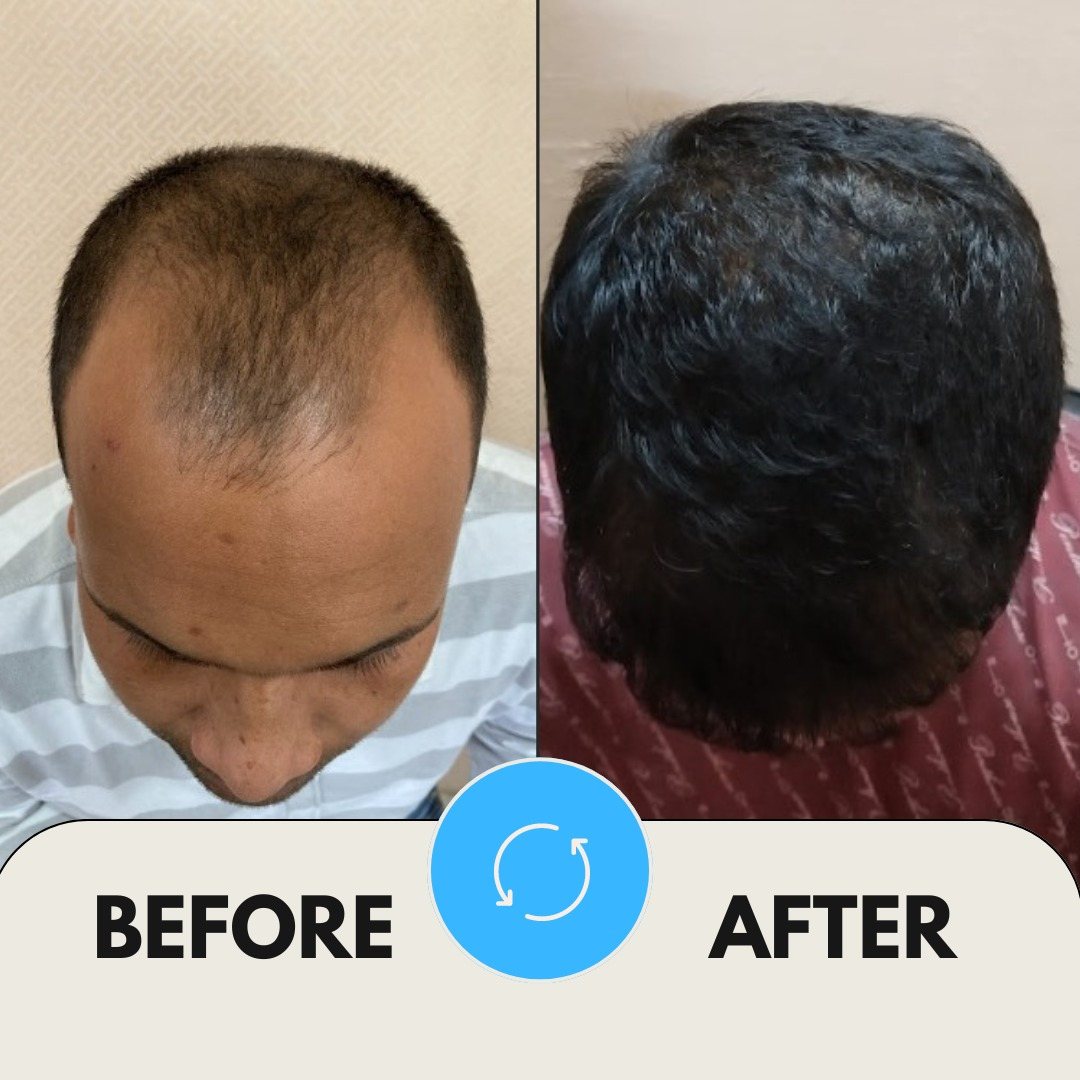
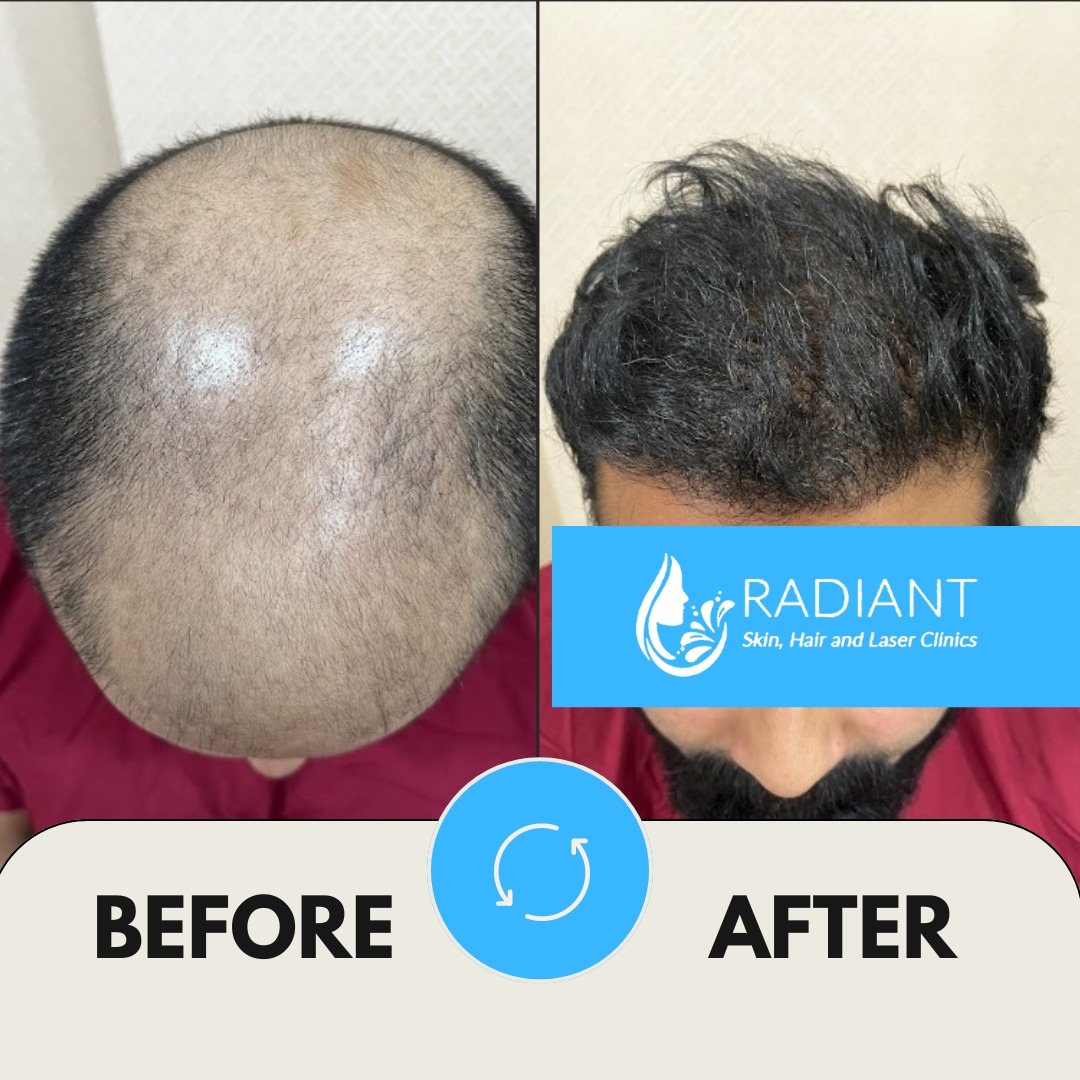
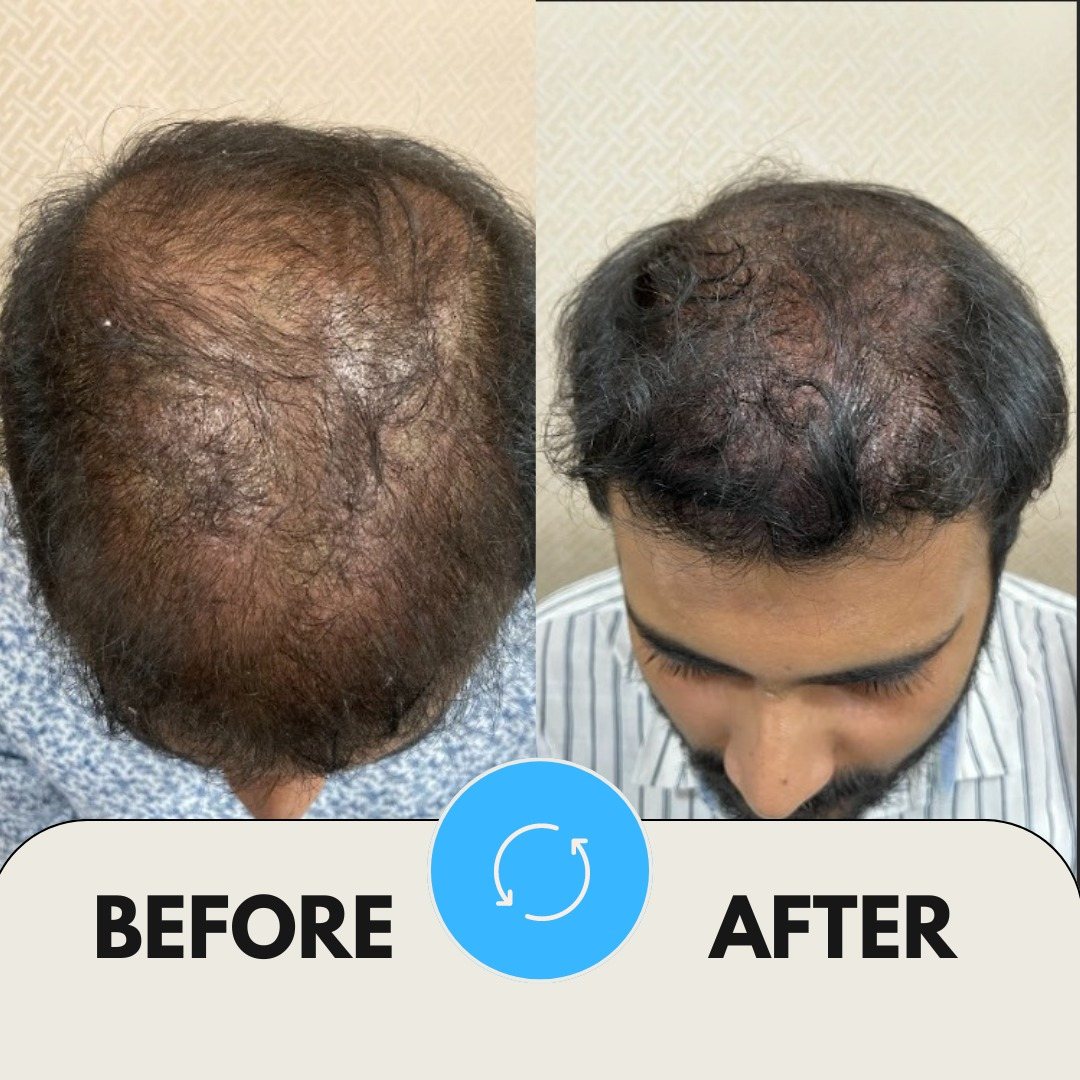
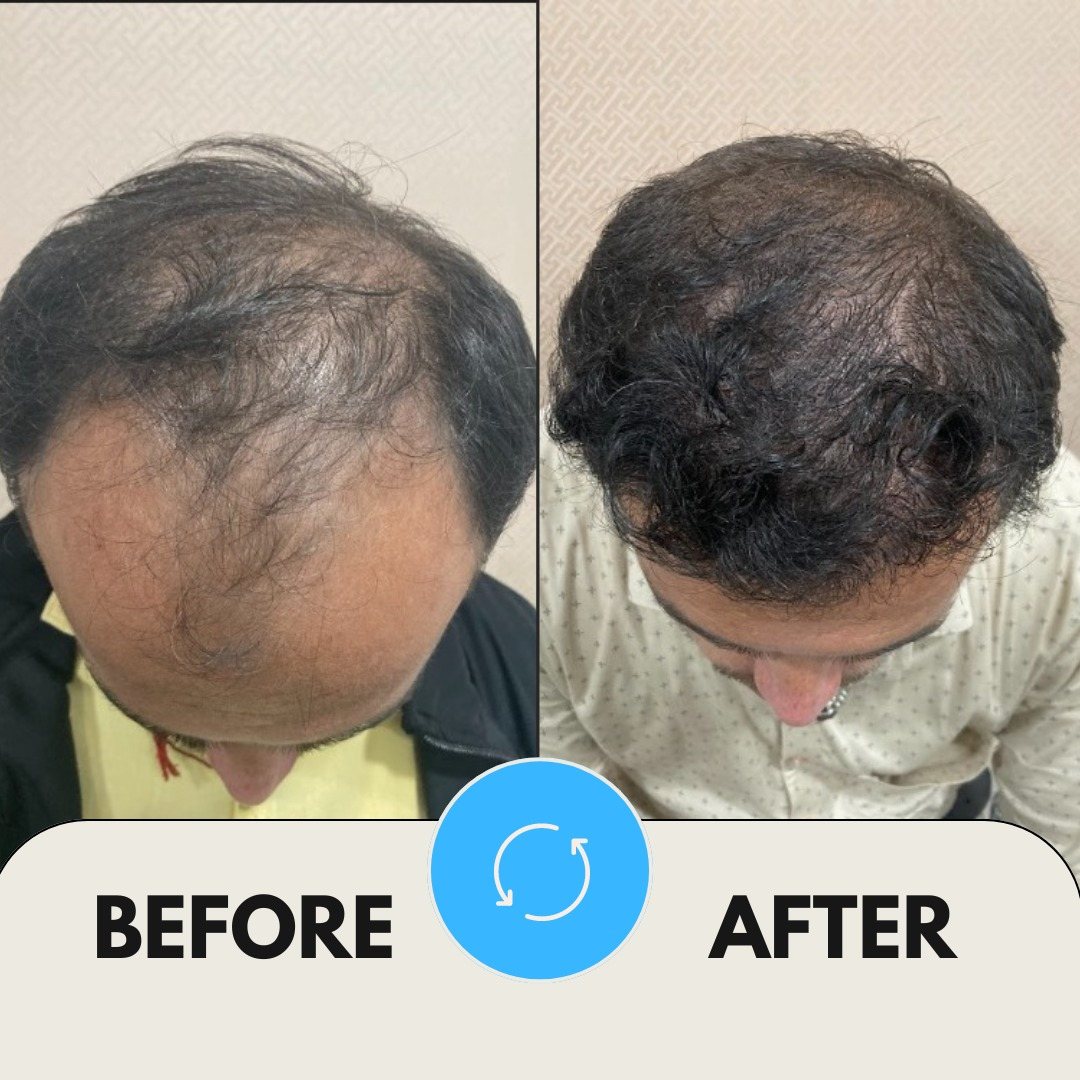
Photographs of patients treated at Radiant Skin, Hair & Laser Clinic, published with written consent. Results vary with donor density, hair calibre, degree of loss at the time of surgery and adherence to aftercare — these are the outcomes these particular patients achieved, not a prediction of yours. What is realistic in your case is set out at the consultation.
"Very knowledgeable doctor, always listens to issues with patience and empathy. Best hair transplant expert and results are amazing."
"Wonderful results after hair transplant."
The surgeon matters more than the machine
Every clinic in Indore offers FUE and the equipment is broadly the same. Three decisions made on the day cannot be undone: where the hairline sits, how much donor area is spent, and at what angle the grafts go in. All three are surgical judgement. All three are routinely delegated.
He does the surgery. Not a technician.
Extraction, site creation and implantation are all done by Dr. Malviya. At most clinics a doctor consults and signs while technicians operate — legal, widespread, and the biggest unexplained gap between two quotes at the same price.
MD dermatologist, former AIIMS faculty.
Hair loss is a dermatological condition before it is a surgical one. Catching the scarring alopecia or thyroid disease that makes surgery pointless sits inside dermatology, not inside a transplant course.
5,000+ procedures across 15 years.
Graft placement can be taught in months. Knowing where a hairline belongs on a 32-year-old with a Norwood 6 family history takes years — and it is the one part of the operation you cannot judge in advance.
Your donor area is a lifetime budget.
You have roughly 6,000–8,000 extractable grafts and they never grow back. The plan holds grafts in reserve for loss that has not happened yet, instead of spending everything today.
Patients get turned away.
If your loss has not stabilised, or your donor density cannot cover the area you want, you leave with a prescription and a six-month review instead of a surgery date. That costs the clinic a case.
The number is on paper before you decide.
Graft count from a dermoscopic measurement, the per-graft rate, what is included, the total — written down at the consultation, with no pressure to book the same day.
The hairline that still suits you at fifty matters more than the one you want at thirty.
This is the part you are actually paying for
Not the consultation, not the waiting room. These are photographs from procedures at Radiant — Dr. Malviya with the instruments in his hands, which is where he is for the full six to eight hours of every case.


Why this matters more than any claim on this page. Graft survival, hairline angle and final density are decided in these two steps — site creation and implantation. At a clinic where technicians perform them, the surgeon’s qualification is on the invoice but not in the result. Ask any clinic you are comparing for photographs of their doctor operating, and watch what comes back.
Four things to check before you book a hair transplant — at any clinic in Indore
Two quotes for the same graft count can differ by a factor of three, and the brochure will not tell you why. These four questions will. Ask them here, and ask them everywhere else you are considering.
Ask for the surgeon’s medical registration number
Every doctor practising in India holds a registration with a state medical council, and the register is public. A qualified dermatologist or plastic surgeon will give you the number without hesitating. Hair transplantation is surgery; it is not a certificate course, and “hair specialist” is not a medical qualification.
At Radiant: Dr. Abhishek Malviya, MBBS, MD (Dermatology, Venereology & Leprosy), registered with the Madhya Pradesh Medical Council. Ask at reception and the number is handed to you.
Ask who will hold the punch — and get it in writing
This is the single largest unexplained difference between two clinics charging similar money. In a great many clinics the doctor designs the hairline, signs the file and leaves; technicians do the extraction and the implantation. It is widespread and it is legal. It is also why identical graft counts produce very different heads of hair.
At Radiant: Dr. Malviya performs extraction, site creation and implantation personally, on every case. You can have that written on your plan.
Ask for the graft count and the per-graft rate, separately
A package price hides the arithmetic. If a clinic quotes ₹60,000 without telling you the graft count, you cannot tell whether you are buying 1,200 grafts or 2,500 — and the difference is the entire result. A per-graft rate plus a counted plan is auditable; a package is not.
At Radiant: priced per graft. Your count comes from a scalp examination with dermoscopy and both numbers go on paper before you commit.
Ask to see results at twelve months, with graft counts stated
A transplant looks its best at ten to twelve months, so a gallery of three-month photographs tells you nothing. Ask for fixed angles, consistent lighting, the graft count for each case and the interval at which the photograph was taken. Galleries without those four things are marketing, not evidence.
At Radiant: every case on this page carries its Norwood stage, graft count and the month the photograph was taken — including one shown at six months, mid-growth.
What actually differs between two quotes
Two clinics can quote a similar figure for the same graft count and deliver results a decade apart in quality. These are the variables that explain it. Take the right-hand column with you.
| Variable | At Radiant | Ask this elsewhere |
|---|---|---|
| Who extracts and implants | Dr. Malviya, personally | "Will the doctor hold the punch, or a technician?" |
| Surgeon's qualification | MD Dermatology · ex-AIIMS faculty | "What is your postgraduate qualification?" |
| How graft count is set | Dermoscopic donor measurement | "How did you arrive at that number?" |
| Pricing structure | Per graft, itemised, in writing | "Is this a package? How many grafts exactly?" |
| Donor planning | Reserve held for future loss | "How many grafts am I leaving for later?" |
| Follow-up | Week 1, month 3, 6 and 12 | "How many reviews are included?" |
| Therapy afterwards | Prescribed to protect native hair | "What stops the rest of my hair thinning?" |
| Unsuitable candidates | Declined, reviewed in 6 months | "When do you tell someone not to do this?" |
Know your graft count before you walk in
Select the pattern closest to yours. The range is enough to sanity-check any quote you are given. Your confirmed number comes from a dermoscopic measurement of donor density.
Norwood stage → graft estimate
Tap the diagram that matches your pattern. Shaded areas show where hair has been lost.
The earliest stage usually considered for surgery. Frontal hairline and temples. · For per-graft pricing and worked examples, see hair transplant cost in Indore.
| Stage | Pattern | Typical grafts | Planning note |
|---|---|---|---|
| Norwood 1 | No visible recession | Not a surgical case | A normal adult hairline with no meaningful loss. No surgery indicated. |
| Norwood 2 | Slight temple recession | 500 – 1,200 | Hairline refinement only. Most men at this stage are advised medical therapy first. |
| Norwood 3 | Deep frontal recession | 1,000 – 1,800 | The earliest stage usually considered for surgery. Frontal hairline and temples. |
| Norwood 3V | Recession plus crown | 1,500 – 2,200 | Recession at the front with a separate thinning patch at the crown. |
| Norwood 4 | Frontal and crown loss | 2,000 – 3,000 | A defined band of hair still separates the front from the crown. |
| Norwood 5 | Bridge narrowing | 2,500 – 3,500 | The band between front and crown is thinning. Donor planning becomes critical. |
| Norwood 6 | Bridge gone, areas merged | 3,500 – 4,500 | Front and crown have merged into one bald area. Often staged across two sessions. |
| Norwood 7 | Horseshoe pattern only | 4,500 – 6,000+ | Only a horseshoe of donor hair remains. Coverage goals must be set realistically. |
Ranges follow International Society of Hair Restoration Surgery planning guidance and the clinic's own case data. Donor density and hair calibre move the figure more than the Norwood stage alone — which is why a number quoted without examining your scalp is a guess, not an estimate.
One day, local anaesthesia, home by evening
You are awake throughout. You can eat, use your phone and watch something. Six to eight hours for 2,000–3,000 grafts.
Assessment & blood work
Dermoscopic scalp examination, blood tests and baseline photographs from fixed angles. You leave with your graft count, the plan and the total cost in writing.
Hairline designed with you
Drawn in a mirror with you sitting upright, not lying down. Set from facial proportion and age, with a deliberately irregular edge — a straight hairline is the clearest giveaway. You approve it first.
Extraction
Micro-punch sized to your follicle calibre, spread across the whole donor zone so no area is visibly thinned. Over-harvesting one patch is what creates a moth-eaten donor area.
Recipient site creation
Sites made at the angle, direction and density of the hair that grew there — acute at the frontal edge, turning across the crown whorl. This decides whether the result reads as hair.
Implantation
Single-hair units at the front edge for a soft transition, two and three-hair units behind for density. Grafts stay in chilled preservation solution; time out of the body determines survival.
Discharge
Dressing, prescriptions and a written aftercare sheet covering washing, sleeping and the first fortnight — plus the clinic's number for anything that worries you.
What happens over the next twelve months
One thing to know before you start: transplanted hair falls out before it grows back. Patients who were not warned find this alarming. It is normal and it is not graft failure.
Soreness & small scabs
Controlled with simple painkillers. Forehead swelling on days two to three settles by itself. Sleep semi-upright.
First wash, back to normal
Washing starts day three exactly as instructed. Desk work from day three to five. By day ten the scalp looks unremarkable.
Shedding phase
Transplanted hairs shed while the follicles stay alive beneath the skin. Nothing has gone wrong.
Growth begins
Fine new hairs appear, unevenly at first. Occasional small spots around emerging hairs are normal.
Clearly visible change
Around 50–60% of final density, still thickening. The first comparison photograph that feels satisfying.
Final result
Texture normalises and density matures. Assessed and photographed from the same angles as your pre-operative set.
Protecting native hair
The grafts are permanent; your own hair is not. Medical therapy continues so untransplanted areas do not thin around the new hair.
Four reviews included
Week one, month three, month six and month twelve — each against your baseline photographs, so progress is measured rather than remembered.
Swelling, soreness, scabbing, shock loss
All temporary. Shock loss — some existing thin hair shedding near the grafts — regrows in three to four months.
Folliculitis, uneven density
Small inflamed spots at months three to four usually settle with topical treatment. Uneven density follows poor site planning.
Infection, poor survival, donor depletion
Infection is rare under sterile conditions. Poor survival traces to graft handling. Donor depletion follows over-harvesting and cannot be reversed.
All risks and the realistic expected outcome are explained and documented as part of informed consent, with time to ask questions before you decide.
What it costs, and how the number is built
Priced per graft — so you can check the arithmetic
There is no single price for a hair transplant, and a figure quoted before anyone has examined your scalp is a package, not an estimate. Per-graft pricing means the total follows a number you can verify: graft count × rate.
The per-graft rate, what the price includes — consultation, procedure, medication, post-op kit and four follow-up reviews — worked examples for each graft count and EMI options are set out in full on the cost page.
See hair transplant cost in IndoreTen questions worth asking every clinic
Ask these here and at every clinic you shortlist. The answers separate surgeons from sales desks faster than any brochure.
- Who holds the punch?Not who consults you — who performs the extraction and implantation.
- What is the surgeon's postgraduate qualification?An MD, DNB or surgical degree, not a short certification course.
- Is the price per graft or a package?Packages conceal the graft count, the only figure that lets you compare quotes.
- How was my graft count calculated?It should follow a dermoscopic donor measurement, not an eyeballed guess.
- How many grafts are left for future loss?A good answer plans for balding that has not happened yet.
- Can I see your own cases, with graft counts and dates?Same angles, same lighting, stated intervals.
- What is your written policy if grafts do not grow?Get it before surgery, not after month six.
- How many follow-ups are included?Week one, month three, six and twelve should be standard.
- What medical therapy will I need afterwards, and why?"None" is a warning sign — native hair keeps thinning.
- When do you tell a patient not to have surgery?A clinic that never does is selling, not treating.

MBBS, Government Medical College, Jabalpur. MD in Dermatology, Venereology & Leprosy, Government Medical College, Patiala. Former Assistant Professor of Dermatology, AIIMS. Lifetime member of IADVL and the Indian Medical Association. Listed among the top three dermatologists in Indore by ThreeBestRated. Faculty and speaker at national and international hair-restoration workshops.
Full profile & credentialsHair transplant in Indore — the facts on one screen
Everything a first consultation would otherwise take an hour to establish.
| Surgeon | Dr. Abhishek Malviya — performs the procedure personally |
|---|---|
| Qualification | MBBS, MD (Dermatology, Venereology & Leprosy); former Assistant Professor of Dermatology, AIIMS |
| Experience | 15+ years in dermatology; 5,000+ hair transplants performed |
| Technique | FUE — Follicular Unit Extraction, no linear scar, no sutures |
| Typical graft range | 1,000–1,800 for a receding hairline · 2,000–3,000 front and crown · 3,500–4,500 advanced loss |
| Pricing basis | Per graft, quoted in writing before you decide — no package pricing |
| Anaesthesia | Local, with the patient awake and comfortable throughout |
| Session length | 6–8 hours for 2,000–3,000 grafts, in a single day |
| Hospital stay | None — day care, home the same evening |
| Back to desk work | 3–5 days; scabs clear by day 7–10 |
| First visible growth | Month 3–4 |
| Final result assessed | Month 10–12 |
| Clinic | Radiant Skin, Hair & Laser Clinic, Krishna Tower, Pipliyahana, Indore |
| Consultation | Scalp examination with dermoscopy, graft count, written plan and full cost — no obligation to book the same day |
Treating Indore — and most of the Malwa region
The clinic sits at Krishna Tower, Pipliyahana, on the ring road side of the city, so it is reachable from the eastern and western ends of Indore without crossing the centre. Out-of-town patients are scheduled so that consultation and surgery can be combined into as few trips as possible.
Patients also travel in from Dewas, Ujjain, Pithampur, Khargone, Khandwa, Ratlam, Dhar, Shajapur and Jhabua, and from Bhopal when they want the surgery done by the doctor they consulted rather than by whoever is rostered that day.
Planning the trip
- Consultation45–60 min
- Surgery day6–8 hours
- Overnight stay neededNo
- First reviewDay 7–10
- Follow-up reviewsMonth 3, 6, 12
- Reviews by videoYes, for outstation patients
Outstation patients are usually able to combine the consultation and the procedure, provided the scalp examination and blood work are cleared on the first visit. Call ahead so the day is blocked for you.
What patients ask before booking
Not answered here? Message the clinic on WhatsApp and you will hear back within working hours.
Ask on WhatsAppWho is the best hair transplant surgeon in Indore?
Judge it on three things: postgraduate qualification, how many procedures the surgeon has personally performed, and whether he operates himself. Dr. Abhishek Malviya holds an MD in Dermatology, Venereology and Leprosy from a government medical college, served as Assistant Professor of Dermatology at AIIMS, has performed over 5,000 hair transplants across 15+ years, and does the extraction and implantation personally at Radiant Skin, Hair & Laser Clinic, Pipliyahana. He is listed among Indore's top three dermatologists by ThreeBestRated.
Who will actually perform my hair transplant?
Dr. Malviya. He designs the hairline, extracts the grafts, creates the recipient sites and implants them. Ask this everywhere you compare — at many clinics the doctor consults and technicians operate, which is the main reason results differ so widely at similar prices.
How much does a hair transplant cost in Indore?
Radiant prices per graft, so the total follows your graft count rather than a package you cannot audit. Most cases fall between 1,500 and 4,500 grafts. Your count comes from a scalp examination with dermoscopy and the full cost is given to you in writing at the consultation. Current rates and worked examples are on the hair transplant cost page.
How many grafts will I need?
Typically 1,000–1,800 for a receding hairline, 2,000–3,000 for front and crown, and 3,500–4,500 for advanced loss. The estimator on this page gives the range for your Norwood stage; the confirmed number depends on donor density and hair calibre measured at the consultation.
Is a hair transplant permanent?
Yes. Grafts come from the back and sides of the scalp where follicles are genetically resistant to DHT and do not bald, and they keep that resistance after being moved. Your remaining native hair can still thin, which is why medical therapy continues afterwards.
How long does it take and when can I return to work?
Six to eight hours for 2,000–3,000 grafts, in one day under local anaesthesia, home the same evening. Most patients are back at desk work in three to five days and scabs clear by day seven to ten.
When will I see results?
Transplanted hair sheds between weeks two and six — expected, not a failure. Growth begins at month three to four, is clearly visible by month six, and the final result is assessed at ten to twelve months.
Why does Radiant do FUE rather than FUT?
FUE leaves scattered dot scars instead of one linear scar across the back of the head, so you keep the option of wearing your hair very short. Recovery is faster and there are no sutures. FUT yields more grafts per sitting, but large cases can be staged instead.
Do you ever advise against surgery?
Regularly. Operating on loss that has not stabilised, or on a donor area that cannot support the coverage requested, produces a result that looks wrong within a few years. Those patients start on medical therapy and are reviewed in six to twelve months.
What happens if the grafts do not grow?
Survival depends on graft handling, time out of the body and site creation — which is exactly why the doctor performs those steps. Growth is reviewed at months three, six and twelve against baseline photographs. Ask every clinic what their written policy is before you book.
Can I see real patient results first?
Yes. Before-and-after photographs from fixed angles under the same lighting, with graft counts and intervals stated, are shown at the consultation. Be wary of galleries with no graft counts, no timeframes and inconsistent lighting.
How do I book a consultation?
Call or WhatsApp +91 98260 54185, or use the form on the contact page. The consultation covers scalp examination with dermoscopy, your graft count, a written plan and the full cost. There is no obligation to book the procedure the same day.
Is a hair transplant in Indore as good as one in Delhi or Mumbai?
The result depends on the surgeon, not the city. What a metro adds is overhead, and what it often adds alongside it is a technician-led model, because high-volume centres cannot have one doctor operating on every case. At Radiant in Indore the operating surgeon is an MD dermatologist and former AIIMS faculty member who performs the surgery himself, which is the variable that actually decides the outcome. Patients travelling to a metro should ask that same question there before paying the difference.
How do I verify a hair transplant surgeon's qualifications in India?
Ask for the doctor's name as registered and their state medical council registration number, then check it on the public register. A hair transplant is surgery, so the operating doctor should hold a recognised postgraduate qualification — MD in Dermatology, or MS/MCh in plastic surgery. Dr. Abhishek Malviya holds an MBBS and an MD in Dermatology, Venereology and Leprosy and is registered with the Madhya Pradesh Medical Council.
Do you treat patients travelling from Dewas, Ujjain, Mhow or Pithampur?
Yes, and from Dhar, Khandwa, Khargone, Ratlam, Shajapur and Jhabua. The procedure is day care, so no overnight stay is required. Outstation patients are usually scheduled so the consultation and surgery fall in the same visit where the scalp examination and blood work allow it, and later reviews can be done by video with photographs.
What proportion of transplanted grafts actually grow?
In well-run FUE, survival is typically quoted in the region of 90–95 per cent, but that figure is earned in the operating room rather than promised in a brochure. It depends on how gently grafts are extracted, how long they spend outside the body, how they are stored and how the recipient sites are made — all steps performed personally by Dr. Malviya here. Growth is reviewed against baseline photographs at months three, six and twelve.
Is a hair transplant safe?
It is a day-care procedure under local anaesthesia with a well-established safety record, and the common after-effects — soreness, swelling, small scabs and temporary shedding of the transplanted hair — are expected rather than complications. The real risks are infection, poor graft survival and donor depletion, and all three track back to surgical technique and case selection. Blood work is done before surgery and anyone whose loss has not stabilised is advised to wait.
Before you decide, four things worth reading
Written by Dr. Malviya’s team at Radiant. No sales pitch in any of them — they exist so you arrive at the consultation already knowing what to ask.
FUE vs FUT hair transplant: which one, and why it matters
Scarring, graft yield, recovery and cost compared side by side — and the cases where FUT is still the better answer.
Read the guide →PlanningHow many grafts does a hair transplant actually need?
How surgeons arrive at a number, why density is measured per square centimetre, and why your donor area sets the ceiling.
Read the guide →RecoveryHair transplant recovery, day by day to month twelve
What each week looks like, when shedding happens and why it is normal, and the point at which you can judge the result.
Read the guide →LongevityIs a hair transplant permanent? What it looks like ten years on
Why transplanted hair keeps growing when native hair does not — and the planning mistake that makes a good result age badly.
Read the guide →Before, or instead of, surgery
Hair Transplant Cost in Indore
Per-graft rate, worked examples by graft count, what the price includes, EMI options.
hair transplant cost in Indore →PRP Hair Treatment
Thickens hair that is still growing. Used to stabilise before surgery and protect native hair after it.
PRP treatment in Indore →Hair Fall Treatment
Start here if your loss is still active. Tests to find the cause, then therapy to stabilise it.
hair fall treatment in Indore →Get your graft count and your price in writing
Scalp assessment with dermoscopy, a written plan, the full cost — and no obligation to book on the day.